
Every startup faces the same early dilemma: build for iOS, build for Android, or somehow do both — without burning through your runway before you’ve even validated the idea.
For years, that choice felt like a trade-off. Native performance meant two separate teams, two codebases, and twice the cost. Hybrid solutions offered convenience but often delivered a compromised experience that frustrated users and developers alike.
Flutter changes that equation entirely. And in 2026, it’s no longer a bold bet — it’s the strategic default for startups that want to move fast, spend wisely, and ship something worth using.
ـــــــــــــــــــــــــــــــــــــــــــــــــــــــــــــــــــــــــــــــــ
Let’s start with numbers, because when you’re pre-Series A, they’re everything.
A typical dual-native build — separate iOS and Android apps — takes 6 to 12 months and costs anywhere from $150,000 to $500,000. For a seed-stage startup operating on a $500K–$2M round, that timeline doesn’t just strain the budget. It threatens the entire company.
Flutter compresses that dramatically. By sharing a single codebase across platforms, development time drops by 40–60% compared to native builds. QA teams test one implementation instead of two. Designers maintain one design system instead of managing platform-specific deviations.
The downstream effect: you get to market faster, iterate on real user feedback sooner, and extend your runway for the things that actually matter — product-market fit, growth, and hiring.
ـــــــــــــــــــــــــــــــــــــــــــــــــــــــــــــــــــــــــــــــــ
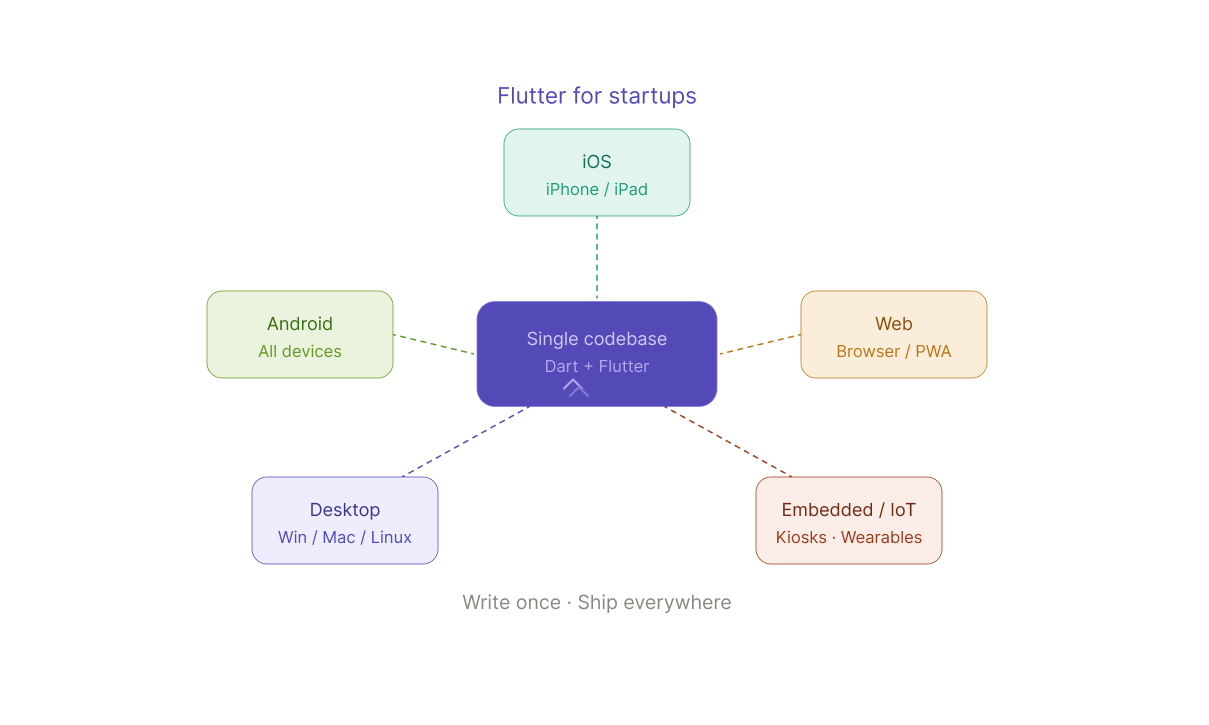
Flutter isn’t just a mobile framework. It’s a multi-platform toolkit.
Write your code once in Dart, and your app runs natively on iOS, Android, web, Windows, macOS, Linux, and even embedded devices. For a startup, this has compounding advantages.
Your MVP launches on both major mobile platforms simultaneously. As your product matures, web and desktop support comes from the same codebase — not a separate engineering effort. And when enterprise clients ask about a desktop dashboard or an internal web tool, you don’t need a new team to build it.
Nearly 46% of developers worldwide now choose Flutter for cross-platform development, according to Statista. By mid-2025, Flutter powered an estimated 1 in 4 new mobile apps across iOS and Android. These aren’t vanity stats — they reflect a growing consensus among engineering teams that Flutter is the most efficient way to ship cross-platform products.
One of the lingering myths about cross-platform development is the performance gap. The assumption: if it’s not native, it’s slower, jankier, and somehow “less real.”
Flutter addresses this at the architecture level.
Unlike frameworks such as React Native that rely on JavaScript bridges to communicate with native components, Flutter compiles directly to native ARM machine code via Dart’s ahead-of-time (AOT) compilation. It renders its own UI using the Impeller engine — the same graphics infrastructure that powers Chrome — rather than relying on native platform components.
The result is near-native performance with consistent behavior across platforms. Animations are smooth, scrolling is fluid, and the app responds the way users expect.
LG’s engineering team captured this well when they rewrote an app in Flutter: without any optimization, it launched twice as fast, consumed less memory, and felt more responsive. That experiment led LG to ship Flutter-built apps across their 2025 televisions globally.
This is increasingly the story for production teams worldwide: Flutter surprises you with how much it delivers without special treatment.
Speed of iteration is everything in the early stages of a startup. You form a hypothesis, ship a feature, watch what users do, and adjust. The faster that loop runs, the faster you find what works.
Flutter’s Hot Reload feature makes this loop faster than anything available in native development.
Change a line of code, and you see it reflected live on the running app — in under a second — without losing the current state. A designer wants to tweak a color? Done in real time. A PM wants to test two versions of a call-to-action? Swap it and see. No rebuild. No re-navigation to the right screen.
This isn’t just a developer convenience. It fundamentally changes how closely design and engineering can collaborate, and how quickly a team can respond to feedback from users or stakeholders.
A common concern with newer frameworks is the risk of betting on something that hasn’t been stress-tested at scale. Flutter clears that bar decisively.
Major global enterprises are running Flutter in production: BMW powers its international myBMW app with Flutter. Alibaba’s Xianyu serves millions of daily users. Talabat, the MENA region’s leading on-demand delivery platform, operates across 8 countries on Flutter. Nubank, one of the world’s largest digital banks, uses Flutter to unify their mobile experience and accelerate feature rollout.
Among funded startups founded after 2021, 38% of those building cross-platform applications chose Flutter — compared to 23% for React Native.
On GitHub, Flutter has over 170,000 stars and 34,500 commits, ahead of React Native on both counts. The community is active, the plugin ecosystem is broad, and pub.dev — Flutter’s package registry — continues to grow with production-grade libraries for everything from payments to analytics to real-time databases.
Startups live and die by their user experience. A clunky app doesn’t just fail to retain users — it signals a lack of craft, and in competitive markets, craft matters.
Flutter was designed with UI as a first-class concern.
Its widget library is rich and deeply customizable. It ships with Material Design and Cupertino components out of the box, giving you a solid foundation that looks right on both Android and iOS. But Flutter doesn’t constrain you to those defaults — you can build fully custom UI systems, pixel-perfect to your brand, without fighting the framework.
Because Flutter owns its rendering pipeline entirely, what you design is what gets rendered — consistently, across every device and platform. There’s no platform-specific quirk that subtly breaks your layout on one device but not another.
For startups building consumer products where brand identity is a competitive differentiator, this matters. You’re not just shipping functionality — you’re shipping a feeling.
2026 is also the year Flutter doubles down on AI integration.
Google positioned Flutter at its I/O 2025 keynote as the framework for building “agentic apps” — applications where AI determines the next UI state and Flutter renders it. The Flutter AI Toolkit reached v1.0 in December 2025, shipping with pre-built chat widgets, multi-turn function calling, and speech-to-text support.
For startups building AI-native products — conversational interfaces, intelligent recommendations, adaptive UIs — Flutter is now a purpose-built environment, not an afterthought.
If you’re a startup founder or CTO evaluating your mobile stack, Flutter isn’t a risk to be managed. It’s a lever.
The question isn’t whether Flutter is ready for your startup. The question is whether your startup is ready to take advantage of what Flutter makes possible.
At K3 Studios, we build Flutter applications for startups and growing businesses across the UAE and beyond. From initial MVP scoping to full-scale product delivery — including UI/UX design, branding, and web development — we handle the full product build so your team can focus on growth.